

As part of our “Health at home” campaign, today I would like to draw your attention to a few aspects of protecting spinal health for all of you who do office work, meaning you spend more than 4 hours a day at a desk. Although office work seems free of physical risks, it can put considerable pressure on the spine. Long hours spent in front of a computer, in a static position, can lead to various conditions, including lower back pain, neck pain and muscle tension. As a physiotherapist, I want to offer you some friendly, easy-to-follow tips to prevent and manage these problems.
The risks of office work for spinal health come from 3 factors:
- Static posture: we are not designed to stay still for long periods. Holding a static position for a long time can lead to muscle tension and pain in the lower back and neck. Lack of movement reduces blood circulation and can cause stiffness and discomfort.
- Poor ergonomics: using non-ergonomic office equipment can make spinal problems worse. A monitor that is too low or too high, a chair without adequate lumbar support, and a poorly placed keyboard or mouse all contribute to poor posture.
- Stress and tension: office work can be stressful, and chronic stress can lead to muscle tension and back pain. Stress also affects posture, causing people to adopt awkward positions.
- Repetitive movements in poor postures create, over time, musculoskeletal imbalances that lead to disease. The musculoskeletal imbalances that lead to disease are of the anteroposterior cervicothoracic type and the thoracolumbar type.
Solutions for preventing and treating spinal conditions
Correct posture at the desk
- The chair: make sure your office chair provides adequate lumbar support. Adjusting the chair height so that your feet are flat on the floor and your knees form a 90-degree angle can make a big difference.
- The monitor: place the monitor at eye level to avoid tilting your neck. The ideal distance from the monitor is about an arm's length.
- Keyboard and mouse: keep the keyboard and mouse at a height that lets your arms stay parallel to the floor and your elbows form a 90-degree angle.
Frequent breaks: Stand up and take a few steps every hour. Regular breaks help improve circulation and reduce muscle tension. Simple stretching exercises can prevent stiffness and discomfort.
Muscle strengthening exercises, with or without BackFix:
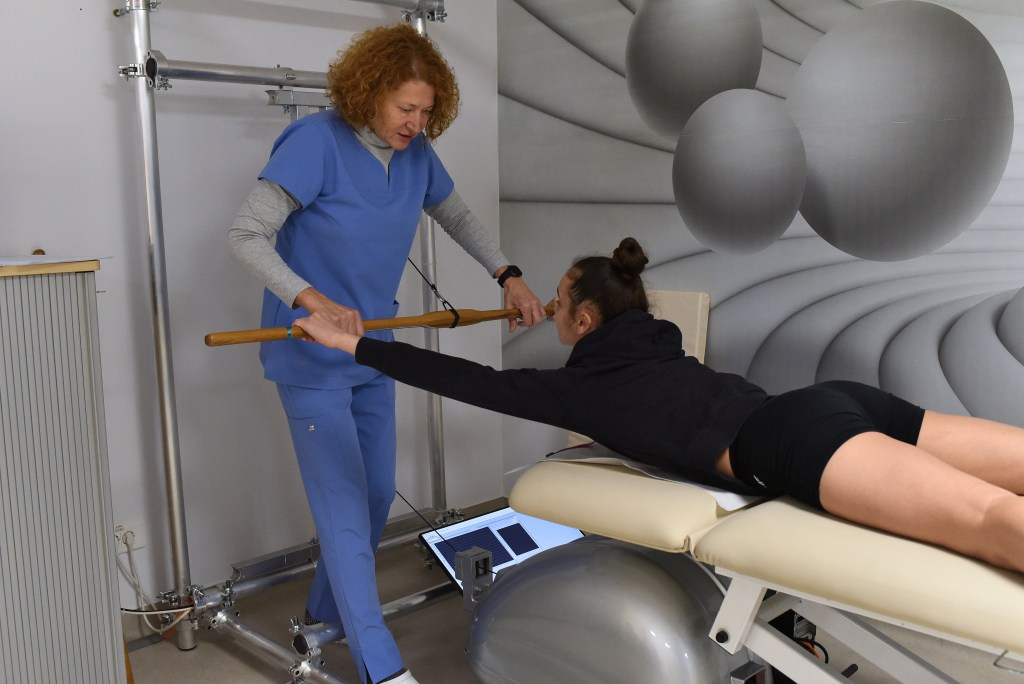
- Musculoskeletal imbalances can be assessed precisely with two categories of investigations: subjective-qualitative and objective-quantitative. Separately or together, they precisely indicate the level of anteroposterior cervicothoracic and thoracolumbar imbalance in just 30 minutes. The subjective-qualitative assessments consist of a somatoscopic evaluation (visual study of posture from the front, back and side) and a series of physiological tests made up of movements that reveal the functional state of different body regions and segments. The objective-quantitative assessments consist of computerized measurements using BackFix electronic dynamometers.
- If a certain level of imbalance already exists, it can be corrected by the shortest route using personalized physiotherapy programs, either classic or combined with the BackFix system.
- Both types of evaluation also have scientifically demonstrated preventive value (even if nothing hurts yet, these evaluations can identify qualitative postural imbalances and quantitative musculoskeletal imbalances) and make it possible to set up personalized physiotherapy programs with a preventive effect or therapeutic value.
- Pilates and yoga: these activities strengthen the trunk muscles, providing better support for the spine.
- Strength training at the gym: workouts that focus on the abdominal and back muscles can prevent back pain.
Relaxation techniques: practice relaxation techniques such as deep breathing, meditation or progressive muscle relaxation exercises. These can reduce stress and muscle tension.
Using an adjustable desk: desks that let you change from a sitting to a standing position can be very beneficial. They allow users to alternate between sitting and standing, reducing the risk of spinal conditions.
Regular physical activity: Regular physical activities such as walking, running or swimming can improve flexibility and muscle strength, reducing the risk of spinal conditions.
Consult your physiotherapist for the most personalized advice on recommended forms of movement and for an evaluation of your spinal function.
Conclusion
Office work can put pressure on the spine, but by adopting healthy habits and using the right ergonomic equipment, the risks can be significantly reduced. It is important to be aware of our posture and to take regular breaks to stretch and move. Strengthening exercises and relaxation techniques can also help maintain a healthy spine. If problems arise, it is a good idea to ask a physiotherapist for help with an evaluation and appropriate, personalized treatment. Spinal health is essential for overall well-being and for an active, pain-free life.
If you would like an objective-quantitative BackFix evaluation combined with a qualitative evaluation, we look forward to seeing you at our clinic at Str. Zăgazului, 21-25, Bucharest.
Tel 0723573027 / 0723573028
For telemedicine consultations and functional evaluation, click the link below and take advantage of the free launch offer!
The best evaluation is the one you choose and actually do!
Medisport4Home
Let's stay healthy and fit, whatever challenges we face!
Warmly,
Dr. Daniela Schor, physiotherapist,
Physiotherapy expert