
As part of our “Health at Home” campaign, today we are talking about the muscle and joint balance of the spine.
Your spine is more than the central pillar of your body. It is the foundation of your long-term health, essential for an active, pain-free life. In a world where sedentary lifestyles and poor posture have become the norm, maintaining a robust muscle and joint balance is not just a recommendation, it is an absolute necessity. So how can you live without back pain, without physical limitations and without the fear of an unstable spine? The key does not lie only in genetics or luck, but in building and maintaining a solid muscle and joint balance, the basis for protecting your health in the long term.
Muscle imbalances: the hidden enemies of your spine
Lower back pain is one of the most common conditions affecting quality of life, and its causes are often ignored or treated superficially. Muscle imbalances are a major but frequently overlooked factor that can undermine the stability and function of the spine. A landmark study by Hodges and Richardson (1996) found significant differences in lumbar muscle activation between people with lower back pain and those without. These hidden enemies work insidiously, affecting not only daily comfort but also the ability to carry out ordinary physical activities, gradually turning discomfort into disability.
Stabilization exercises: your shield against lower back pain
Stabilization exercises, designed to strengthen the muscles that support the spine, are an effective shield against back pain. The study by Vera-Garcia et al. (2007) highlights the major benefits of these exercises, which not only improve control of spinal movement but also increase trunk stability against sudden perturbations. Almost paradoxically, seemingly simple exercises, such as balancing on one leg, can have a profound impact on your spinal health. These exercises involve intense activation of the deep muscles, reducing the risk of premature wear of the spine and preventing chronic back pain.
Balance between flexors and extensors: the perfect balance that saves your back
A proper balance between the trunk flexor and extensor muscles is crucial for the structural integrity of the spine. Without this balance, your spine is exposed to disproportionate stress, which can lead to the onset or worsening of back pain. Hembree et al. (2018) found significant differences between men and women in the balance between these muscle groups, and this imbalance can negatively affect how forces are distributed through the trunk. That is why maintaining a perfect balance between flexors and extensors is not just a recommendation, but a vital element in preventing pain and keeping your spine healthy.

To book a telemedicine consultation, click the button below and take advantage of our free launch offer!
Book a consultation!The impact of imbalances on quality of life: too high a price to pay
The consequences of muscle and joint imbalances go beyond occasional discomfort, significantly affecting quality of life. For patients with degenerative spinal deformity, such as those studied by Yang et al. (2020), muscle imbalance is not just a matter of comfort: it is a matter of how they live. In such cases, spinal stability is compromised, leading to severe limitations in daily activities and a dramatic decline in quality of life. In a modern society where quality of life is considered essential, ignoring these imbalances is not an option.
BackFix: your secret weapon in the fight for a healthy back
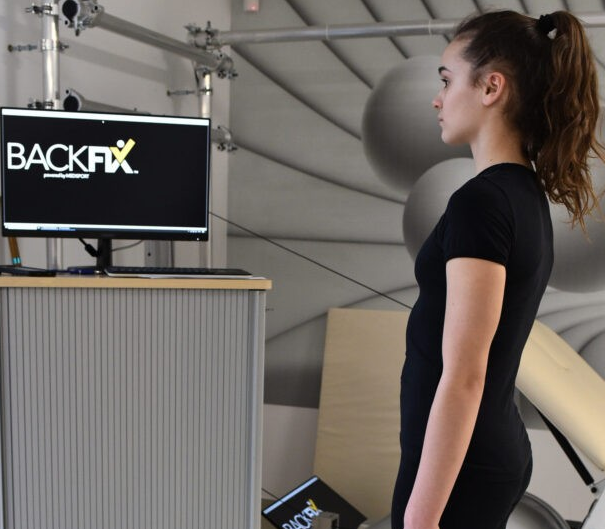
In the age of technology, the assessment and treatment of spinal problems have evolved significantly. BackFix is a cutting-edge innovation that offers an integrated solution for maintaining spinal health. This advanced technology combines assessment of the functional muscle and joint balance of the spine with personalized exercises, monitoring and adjusting position and muscle activity in real time. It is not just another tool, but a trusted partner in your fight for a healthy back, giving you the opportunity to achieve fast, effective and lasting results. With BackFix, you can turn any spinal problem into a clear and definitive victory over pain and discomfort.

Conclusion: don't let your spine's muscle and joint balance become your weak point!
Spinal health is an essential matter that cannot be left to chance. Muscle and joint imbalances can have devastating consequences, but with the right exercises and the right technologies, they can be prevented and managed effectively. Don't wait until the pain becomes unbearable. Act now, build a solid balance and enjoy an active, pain-free life. See a specialist, use modern technologies and protect your spine, for your health today and for your future.
If you would like an objective, quantitative BackFix assessment combined with a qualitative assessment, we look forward to seeing you at our clinic at Str. Zăgazului 21-25, Bucharest, or at Str. Pădurii nr. 94, Copăceni, Ilfov.
Book now!Phone 0723573027; 0723573028
Let's stay healthy and fit, whatever challenges come our way!
Warm regards,
Dr. Daniela Schor, PT,
Physiotherapy expert
References
- Hodges, P. W., & Richardson, C. A. (1996). Inefficient muscular stabilization of the lumbar spine associated with low back pain: A motor control evaluation of transversus abdominis. Spine, 21(22), 2640-2650.
- Hides, J. A., Jull, G. A., & Richardson, C. A. (2001). Long-term effects of specific stabilizing exercises for first-episode low back pain. Spine, 26(11), E243-E248.
- Vera-Garcia, F. J., Elvira, J. L., Brown, S. H., & McGill, S. M. (2007). Effects of abdominal stabilization maneuvers on the control of spine motion and stability against sudden trunk perturbations. Journal of Electromyography and Kinesiology, 17(5), 556-567.
- Hembree, A., Alexander, C., Taylor, C., & Peeler, J. (2018). Is there a gender difference in relative strength between the trunk flexor and extensor muscles? Journal of Back and Musculoskeletal Rehabilitation, 31(4), 747-754.
- Yang, C., Xie, Y., Liu, C., & Zhang, Q. (2020). Isokinetic strength of trunk flexors and extensors muscles in adult men with and without nonspecific back pain: A comparative study. Journal of Physical Therapy Science, 32(6), 440-444.
- Reyes-Ferrada, W., Vargas-Munoz, M., & Sosa-Rodriguez, S. (2021). Role of trunk muscle strength in acute low back pain: A systematic review. Journal of Musculoskeletal and Neuronal Interactions, 21(2), 205-215.
- Gabr, W., & Eweda, R. S. (2015). Effectiveness of a computerized treatment program for the conservative management of low back pain. Clinical Biomechanics, 30(7), 646-652.